Affiliate Disclosure: ZimuShop may earn a commission from qualifying purchases — at no extra cost to you.

Ferret Care Guide for Beginners 2026: Setup, Diet, and Daily Care

As an Amazon Associate, ZimuShop earns from qualifying purchases. Learn more
A ferret is a pocket-sized clown with the energy of a puppy and the curiosity of a cat. It will steal your socks, stash them under the couch, and then fall asleep in a hammock for most of the day. Ferrets are playful, intelligent, and deeply entertaining, and also one of the most high-maintenance small pets you can bring home.
This ferret care guide for beginners covers legality, cage setup, diet, daily play time, and the health warning signs to watch for. We did not hands-on test any products for this guide; it is based on veterinary guidance from VCA Animal Hospitals, the MSD Veterinary Manual, and the RSPCA, plus ferret welfare sources. For general pet care basics, see our complete pet care guide.
Quick Takeaways:
- Ferrets are illegal as pets in California and Hawaii, and some cities ban them too. Check your local laws before you buy or adopt.
- Feed a ferret-specific kibble with 32 to 40 percent protein and 10 to 15 percent fat. Never feed chocolate: it can be fatal.
- A ferret needs at least 3 to 4 hours of supervised out-of-cage play every day, in a ferret-proofed room.
- Ferrets are heat sensitive. Keep their room between 65 and 75 degrees Fahrenheit and never let it reach 90 degrees.
- Find a ferret-experienced veterinarian before you need one. Ferrets live 6 to 10 years and need annual checkups and vaccines.
Are Ferrets Legal Where You Live?
Before you fall in love with a ferret at the pet store, check the law. Ferrets are illegal to keep as pets in two states: California and Hawaii. California has banned ferrets since 1933 under the Fish and Game Code (section 2118) and the state regulations that list ferrets as restricted species, and the state issues no permits for pet ferrets. Hawaii bans ferrets to protect its rabies-free status, and the penalties for keeping one are severe.
Even where state law allows ferrets, your city or county may not. New York City and Washington, D.C. both ban ferrets, and a few states, such as New Jersey and Rhode Island, require a permit to keep one. Landlords and homeowners associations can add their own rules on top of the law. Before you commit, check your state wildlife or agriculture department, your city or county ordinances, and your lease or HOA rules. Laws change, so confirm the current rules.
Ferret Cage Setup
A ferret cage is a bedroom, not a home. Your ferret sleeps, eats, and uses the litter box there, but the real living happens outside the cage during play time.
Cage Size and Layout
There is no single evidence-based minimum cage size for pet ferrets. The RSPCA in Australia notes that published housing guidelines for ferrets come from laboratory settings, not companion-animal research, so no official standard exists for pet ferrets. Every ferret rescue and experienced keeper agrees: bigger is better, and multi-level beats flat.
As a practical floor, one ferret needs a cage at least 36 inches long, 24 inches wide, and 24 inches tall, with two levels connected by ramps. A pair needs more room, and a tall multi-level cage with solid shelves is the standard setup. Scotland’s animal welfare licensing guidance gives a useful reference point: at least 0.6 square metres of floor area per ferret over 12 weeks old, with room to lie fully stretched out and stand upright. Use that as a minimum, not a target.
Layout matters as much as size. Keep sleeping, feeding, and litter areas in separate zones: ferrets will not use a litter box next to their bed. Choose solid floors and shelves: wire mesh hurts ferret feet and can trap toes. Bar spacing should be no wider than 1 inch, because a ferret can squeeze through a gap that looks far too small for its body. For cages, hammocks, and litter boxes, see our small animal products hub.
Bedding, Hammocks, and Hiding Spots
Ferrets sleep deeply, often 14 to 18 hours a day, and they need soft, enclosed places to rest. Hammocks are the classic ferret bed: hang at least two, so one is always clean while the other is in the wash. Add a sleep sack or fabric tube, and an enclosed hideout for retreat. The RSPCA advises providing tunnels and closed hammocks as safe hiding places, because a ferret that feels scared needs somewhere to hide.
Use fleece or old cotton towels for bedding, and wash them weekly. Avoid loose bedding such as wood shavings or dusty paper bedding: ferrets have sensitive airways, and dust can trigger respiratory problems.

Litter Training Basics
Ferrets can learn to use a litter box, and most pick it up quickly, because they back into a corner to eliminate. Put a litter box in the corner of the cage your ferret already uses, and place extra boxes in the corners of the free-roam area. A high-backed litter box works best, because ferrets back up and can miss a shallow tray.
Use a paper-based or pelleted litter made for small animals. Do not use clumping cat litter: ferrets dig in their litter, and clumping litter can stick to paws and be swallowed. Scoop the box daily and wash it weekly. Expect accidents, especially with kits and in a new room: a ferret that is playing hard may not make it back to the box in time. Stay patient and the habit will stick.
Small Pet Equipment for Ferret Owners
Many ferret owners share their homes with other small pets. If you also keep hamsters, our guide to the best silent hamster wheels covers sizing and safety for wheels, and if you keep rabbits, our guide to the best rabbit hay feeders covers feeders that cut hay waste. One rule never changes between species: buy gear sized for the animal you have. A hamster wheel is far too small for a ferret, and a ferret cage is far too open for a hamster.
What Do Ferrets Eat?
Ferrets are obligate carnivores, which means their bodies are built to digest meat and little else. They have a short digestive tract and cannot digest plant fiber. A ferret fed like a rabbit or a hamster will slowly starve on a full bowl.
The staple diet should be a high-quality commercial kibble made specifically for ferrets. VCA Animal Hospitals advises 32 to 40 percent protein, 10 to 15 percent fat, and no more than 4 percent fiber, because ferrets cannot digest more fiber than that. Cat food is less appropriate, and dog food is never suitable. When you read a label, the first ingredients should be named animal proteins, such as chicken or turkey meal. For more on small pet feeding, see our guide to small pet nutrition.
Feed your ferret at all times, not on a schedule. Ferrets eat small amounts often, day and night, so keep the food bowl full and the water fresh. Use a heavy ceramic bowl that resists tipping. Whole-meat or raw diets can work, but VCA warns they can cause nutritional imbalances if they are not balanced properly, so ask your veterinarian before switching.
Foods to avoid are just as important as foods to feed. Never feed chocolate: VCA states that chocolate can be fatal to ferrets. Skip sugary treats, including yogurt drops and sweetened snacks. Sugar is linked to tooth decay and to insulinoma, the pancreatic tumor discussed below. Do not feed fruits or vegetables as staples: a ferret cannot digest them, and they take up stomach space that meat should fill. Dairy is not digestible for ferrets either. Grains, bread, cereal, and pasta have no place in a ferret’s diet. Treats should be meat-based: a small piece of cooked chicken or a freeze-dried meat treat.
Daily Care and Handling
Ferrets are not a pet you can set up and forget. They need hours of your time every day. A bored ferret chews cage bars, bites, and destroys whatever it can reach.
Play Time and Exercise
A ferret needs at least 3 to 4 hours of supervised out-of-cage time every day, and more is better. Many ferrets thrive on 6 to 8 hours. Split the time into two or three sessions: ferrets play in bursts, then crash into a deep sleep. Morning and evening sessions work well, because ferrets are most active around dawn and dusk.
Play should be interactive. Ferrets love tunnels, crinkle toys, balls, and dig boxes filled with rice or strips of paper. Chase games, gentle wrestling, and puzzle feeders all count as exercise. Rotate toys every few days so they stay interesting. Never use rubber toys: swallowed pieces can cause a life-threatening intestinal blockage.
Social Needs
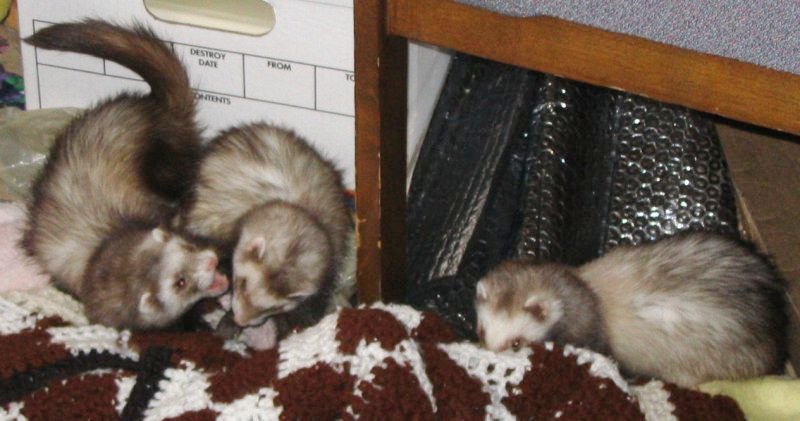
Ferrets are highly social animals. The RSPCA advises keeping ferrets in pairs or small groups, not alone. A pair of ferrets plays together, sleeps piled together, and keeps each other company while you are at work.
A single ferret can be happy only if you are its social life: several hours of handling and play every day, not just an hour after dinner. If you work long hours and live alone, two ferrets are kinder than one. Introduce new ferrets on neutral ground and supervise the first meetings.
Handle your ferret gently and often, starting from the first day. A well-socialized ferret is relaxed about being picked up, carried, and examined. A frightened or poorly socialized ferret may bite. VCA advises speaking with a veterinarian before getting a ferret if you have young children, and supervising all interactions between children and ferrets. Teach children to hold a ferret with two hands, supporting the whole body, and never to grab a ferret by the tail.
Grooming and Nail Trims
Ferret grooming is simple but regular. Trim the claws every two to three weeks: ferret nails grow fast, and long nails catch on fabric and can break. Your veterinarian can show you how to trim safely the first time. Never declaw a ferret: VCA is clear that ferrets should never be declawed.
Bathe your ferret only when it is dirty, and only as often as your veterinarian advises. Bathing will not remove a ferret’s musky odor, which comes from oil glands in the skin, not from dirt. Over-bathing strips the skin’s natural oils and can make the odor worse. De-scenting does not help either: removing the anal scent glands leaves the skin-gland smell untouched. If the smell bothers you, a ferret may not be the right pet for your household.
Common Health Issues and Warning Signs
Ferrets are prone to a handful of common health problems, and most of them show up in middle-aged and older ferrets. This section gives general information only. It is not veterinary advice.
Adrenal Disease
Adrenal gland disease is the most common endocrine tumor in ferrets, according to the MSD Veterinary Manual. The adrenal glands overproduce sex hormones, and the classic first sign is symmetrical hair loss that starts at the tail and creeps up the body, often with itchy skin. A spayed female may develop a swollen vulva, and a neutered male may show sexual behavior again. In males, an enlarged prostate can block urination, which is an emergency. If you notice the tail-first hair loss pattern, book a veterinary visit within days.
Insulinoma
Insulinoma is a tumor of the insulin-producing cells in the pancreas, and it is very common in ferrets over 2 to 3 years old. The tumor makes too much insulin, so blood sugar drops dangerously low. The MSD Veterinary Manual lists the signs: lethargy, a blank glazed stare (often called stargazing), weakness in the hind legs, drooling, pawing at the mouth, and in severe cases collapse, seizures, or coma. A telling clue is that the signs often ease after the ferret eats, because food raises the blood sugar. A ferret that collapses or seizes needs emergency veterinary care immediately.
Dental Problems
Dental disease is extremely common in ferrets and easy to miss. Ferrets over 2 years old often develop tartar, gingivitis, and periodontal disease, and tartar builds with age even on a dry diet. Ferrets also break their long canine teeth by chewing on cage bars and hard objects. A chipped tooth tip is not always an emergency, but a fracture that exposes the pulp can become infected and painful. Watch for bad breath, brown build-up along the gum line, drooling, pawing at the mouth, bleeding gums, or a ferret that suddenly eats on one side or refuses hard food.
Have the teeth checked at every annual visit; a proper cleaning is done under general anesthesia. At home, slow tartar with regular brushing using toothpaste made for cats or dogs. Never use human toothpaste: the MSD Veterinary Manual warns that human fluoride toothpaste is not meant to be swallowed and may be toxic to a ferret.
Common Mistakes New Ferret Owners Make
Most ferret problems are preventable. Check yourself against this list before your ferret comes home.
- Feeding the wrong diet. Dog food, cat food, sugary treats, and fruit are all wrong for an obligate carnivore. Feed a ferret-specific kibble and keep treats meat-based.
- Buying too small a cage. A cage that looks big in the store is often too small once a hammock, litter box, and food bowl are inside. Go multi-level and go bigger than you think you need.
- Skipping out-of-cage time. A ferret locked in its cage all day will be bored, stressed, and destructive. The 3 to 4 hour daily minimum is not optional.
- Bathing away the smell. Frequent baths will not remove the musky odor and can make it worse. Accept the smell or choose a different pet.
- Leaving foam and rubber within reach. Shoe inserts, earplugs, rubber bands, and foam from speakers are all blockage hazards. Ferret-proof the play area before every session.
- Skipping veterinary care. Ferrets need annual exams, distemper and rabies vaccines, and dental checks.
Safety Considerations
Ferrets explore the world with their mouths, and they can get into trouble fast. Safety is a daily habit, not a one-time setup.
Escape-Proofing
Ferrets are famous escape artists. They squeeze through surprisingly small openings, so block every hole that leads somewhere you cannot reach. They burrow into couch and mattress foam and climb into speakers, closets, and drawers. Block access to these areas with thin plywood or hardware cloth. Check the cage latches every day: a ferret that learns to open a simple latch will open it every night. Never leave a ferret unsupervised outside its cage. A breakaway collar with a bell helps you hear where your ferret is; ask your veterinarian about a safe fit.
Heat Sensitivity
Ferrets are highly susceptible to heatstroke. VCA advises keeping ferrets in a cool environment, generally 65 to 75 degrees Fahrenheit (18 to 24 degrees Celsius), and never letting the temperature reach 90 degrees Fahrenheit (32 degrees Celsius). The RSPCA puts the preferred range at 15 to 21 degrees Celsius, never above 29. Keep the cage out of direct sunlight and never leave a ferret in a parked car. A ferret that is panting, drooling, or lying flat and limp may be overheating: move it to a cool room and contact your veterinarian right away.
Toxic Foods and Household Hazards
Chocolate can be fatal to ferrets, and sugary foods and treats should never be offered. Keep human food out of reach during play time. In the play area, remove foam, plastic, and rubber objects: VCA lists shoe inserts, earplugs, erasers, rubber bands, balloons, and speaker foam as items that can cause a life-threatening intestinal blockage if swallowed. If you think your ferret has swallowed something, contact a veterinarian promptly rather than waiting to see if it passes.
Other hazards include open toilets, uncovered drains, reclining chairs, and open washing machines and dryers. Check before you close a door, sit in a recliner, or start a load of laundry, and keep electrical cords covered and poisonous plants out of the play area.
When to Consult a Veterinarian
Find a veterinarian experienced with ferrets before you bring one home, not during an emergency. Not every vet treats ferrets. Ask local ferret rescues or exotic pet groups for recommendations, and book a first exam soon after adoption. VCA advises an exam with a ferret-experienced veterinarian soon after adoption, and at least once a year after that. The first visit usually includes a health check, a fecal test for parasites, an ear mite check, and a vaccination plan.
Ferrets need protection against canine distemper and rabies, and your veterinarian will set the schedule. Ask about heartworm prevention even if your ferret lives indoors, because mosquitoes can enter homes. As ferrets age, regular exams and blood tests help catch insulinoma, adrenal disease, and heart disease early.
See a veterinarian right away if your ferret collapses, seizes, cannot urinate, vomits repeatedly, stops eating for more than a day, has diarrhea with blood, or shows sudden hind leg weakness. Book a routine visit if you notice hair loss, itching, weight loss, bad breath, a broken tooth, or a change in energy or appetite. This article gives general information only. It is not veterinary advice. If your pet shows any of the signs above, or if you are unsure, contact your veterinarian.
Frequently Asked Questions
Are ferrets good pets for beginners?
Ferrets can be wonderful pets for a committed beginner, but they are not low-maintenance. They need 3 to 4 hours of supervised play every day, a meat-based diet, a large cage, and a ferret-experienced veterinarian. If you can give them that time, they are affectionate and endlessly entertaining. If you want a pet that is happy alone most of the day, a ferret is the wrong choice.
How long do ferrets live?
Ferrets generally live about 6 to 10 years, according to VCA Animal Hospitals. Older ferrets need more frequent checkups to catch adrenal disease, insulinoma, and dental disease early.
Can ferrets be litter trained?
Yes. Ferrets naturally back into a corner to eliminate, so place a high-backed litter box in the corner your ferret already uses. Use a paper-based or pelleted litter, never clumping cat litter, and scoop daily. Expect accidents with kits and in new rooms.
What should I feed my ferret?
Feed a high-quality kibble made specifically for ferrets, with 32 to 40 percent protein, 10 to 15 percent fat, and no more than 4 percent fiber, following VCA Animal Hospitals guidance. Keep food available at all times and water fresh. Never feed chocolate, which can be fatal to ferrets, and skip sugary treats, fruit, vegetables, and dairy.
Do ferrets smell?
Yes, ferrets have a natural musky odor that comes from oil glands in their skin. Bathing will not remove it, and neither will de-scenting surgery, because the smell comes from the skin, not the scent glands. A clean cage, clean bedding, and a healthy diet keep the smell at its mildest, but it never goes away completely.
Final Thoughts
Ferrets reward the owners who put in the work. A ferret that gets good food, hours of play, a clean cage, and regular veterinary care is a joyful, bonded companion for 6 to 10 years. This ferret care guide for beginners covers the essentials, but every ferret is an individual, so keep learning from your veterinarian and from experienced ferret owners. If you are still deciding, read our hamster care guide to compare what a lower-maintenance small pet needs, and be honest about the time you can give every day. We are working on guides to the best ferret cages and the best ferret food, which will cover cages and kibble in detail.
Final Thoughts checklist:
- Check that ferrets are legal in your state, city, and lease before you adopt.
- Set up a large multi-level cage with hammocks, hiding spots, and a corner litter box.
- Feed a ferret-specific kibble, keep food and water available at all times, and never feed chocolate.
- Give at least 3 to 4 hours of supervised out-of-cage play every day in a ferret-proofed room.
- Keep the room cool, below 90 degrees Fahrenheit, and never leave a ferret in a hot car.
- Find a ferret-experienced veterinarian now, and book annual exams, vaccines, and dental checks.
How ZimuShop Chooses Products
Every guide on ZimuShop is researched against verified owner reviews, product specifications, brand reputation and recall history. We never accept payment for placement, and ZimuShop is not owned by any pet brand, so our picks stay independent. Prices and availability change often, so check the retailer for the latest details.