Aquarium water quality is the single most important factor in keeping fish healthy and thriving. Unlike terrestrial pets, fish live in a closed environment where they eat, breathe, and excrete in the same water. Understanding and maintaining proper water parameters can mean the difference between a vibrant aquarium and constant fish health problems.
This comprehensive 2026 guide covers everything you need to know about aquarium water quality, from basic chemistry to advanced maintenance techniques. Whether you're a beginner setting up your first tank or an experienced aquarist looking to optimize your water parameters, this guide will provide practical, science-based advice.
Table of Contents
- Why Water Quality Matters for Aquarium Health
- Essential Water Parameters Explained
- The Nitrogen Cycle: Foundation of Aquarium Health
- Water Testing and Monitoring Guide
- Proper Water Change Techniques
- Choosing the Right Filtration System
- Common Water Quality Problems and Solutions
- Weekly and Monthly Maintenance Schedule
- Special Considerations for Planted Tanks
- Saltwater Aquarium Water Quality
- Top Water Quality Products for 2026
- Frequently Asked Questions

Why Water Quality Matters for Aquarium Health
Fish are completely dependent on their aquatic environment. Unlike humans who can move away from poor conditions, fish must adapt to whatever water parameters exist in their tank. Poor water quality is the leading cause of fish illness and death in home aquariums.
When water quality deteriorates, several things happen:
- Ammonia and nitrite toxicity damages gills and internal organs
- Low oxygen levels cause stress and respiratory distress
- pH swings disrupt fish osmoregulation (their ability to maintain internal balance)
- Accumulated waste promotes bacterial and fungal growth
- Heavy metals and toxins can accumulate to dangerous levels
Did You Know?
Fish produce waste constantly through their gills (ammonia) and digestive systems. In a natural environment, this waste is diluted and processed by billions of gallons of water and natural filtration systems. In your aquarium, you must replicate these processes through filtration, water changes, and biological management. According to the American Aquarium Society, 90% of fish health problems can be traced directly to water quality issues.
Recommended Water Testing Kit
Editor's Choice
API Freshwater Master Test Kit
Comprehensive test kit measures pH, high range pH, ammonia, nitrite, and nitrate. Includes 800+ tests. Essential for monitoring aquarium water quality and preventing fish health problems. For planted aquariums, consider our complete planted tank guide which covers specialized water parameters.
Check Amazon PriceEssential Water Parameters Explained
Understanding key water parameters is crucial for maintaining a healthy aquarium. Here are the most important factors to monitor:
Ammonia (NH3/NH4+)
Ideal: 0 ppm
Toxic waste product from fish respiration and decomposition.
Even low levels (0.25 ppm) can stress fish. Must be
converted by beneficial bacteria to nitrite.
Nitrite (NO2-)
Ideal: 0 ppm
Intermediate product in nitrogen cycle. Binds to fish
hemoglobin, preventing oxygen transport. Extremely toxic
even at low concentrations.
Nitrate (NO3-)
Ideal: <20 ppm
Final product in nitrogen cycle. Less toxic but accumulates
over time. Managed through water changes and live plants.
High levels promote algae growth.
pH Level
Freshwater: 6.5-7.5
Saltwater: 8.0-8.4
Measures water acidity/alkalinity. Stability is more
important than exact number. Sudden pH swings are extremely
stressful to fish.
General Hardness (GH)
Varies by fish species
Measures calcium and magnesium ions. Important for fish
osmoregulation, shell/skeleton development in snails and
shrimp. Most community fish prefer moderate hardness.
Carbonate Hardness (KH)
Ideal: 3-8 dKH
Measures carbonate/bicarbonate ions that buffer pH. Prevents
pH crashes. Essential for biological filter function. Low KH
= unstable pH.
Water Parameter Ranges for Common Fish Types
| Fish Type | pH Range | Temperature | GH Range | Special Notes |
|---|---|---|---|---|
| Community Tropical | 6.5-7.5 | 75-80°F | 4-8 dGH | Most adaptable range |
| African Cichlids | 7.8-8.5 | 78-82°F | 10-20 dGH | Require hard, alkaline water |
| Discus | 6.0-7.0 | 82-86°F | 1-4 dGH | Very soft, acidic water preferred |
| Goldfish | 7.0-7.5 | 68-74°F | 4-20 dGH | Tolerant of various conditions |
| Betta Fish | 6.5-7.5 | 78-80°F | 3-5 dGH | Prefer slightly soft water |
Always research specific requirements for your fish species. These are general guidelines.
The Nitrogen Cycle: Foundation of Aquarium Health
The nitrogen cycle is the biological process that converts toxic fish waste into less harmful substances. Understanding this cycle is essential for maintaining aquarium water quality.
Fish Waste and Decomposition
Fish excrete ammonia directly through their gills as a metabolic waste product. Uneaten food and organic debris also decompose into ammonia. This is highly toxic to fish even at low concentrations (0.25 ppm).
Nitrosomonas Bacteria Action
Beneficial bacteria called Nitrosomonas convert ammonia into nitrite. This happens in your filter media, substrate, and aquarium surfaces. Nitrite is still highly toxic to fish, binding to hemoglobin and preventing oxygen transport.
Nitrobacter Bacteria Action
Another group of beneficial bacteria called Nitrobacter convert nitrite into nitrate. Nitrate is much less toxic and can be tolerated at moderate levels (under 40 ppm for most fish).
Water Changes and Plant Uptake
Nitrate accumulates over time and is removed through regular water changes. Live plants also absorb nitrate as fertilizer. In heavily planted tanks or specialized systems, anaerobic bacteria can convert nitrate to nitrogen gas.
Cycling Your Aquarium
Cycling refers to establishing the beneficial bacteria colonies before adding fish. This process typically takes 4-8 weeks. You can accelerate cycling by:
- Adding bacteria starters like API Quick Start
- Using filter media from an established tank
- Adding a small amount of fish food daily to provide ammonia source
- Monitoring with test kits until ammonia and nitrite read 0 ppm
Never add fish until your tank is fully cycled! For a complete guide, see our step-by-step aquarium cycling tutorial.

Water Testing and Monitoring Guide
Regular testing is the only way to know your aquarium's water parameters. Here's what you need to test and how often:
Daily Monitoring
- Temperature (with aquarium thermometer)
- Visual check for cloudy water
- Fish behavior observation
- Equipment operation check
Weekly Testing
- Ammonia (especially in new tanks)
- Nitrite (especially in new tanks)
- Nitrate (all established tanks)
- pH (check for stability)
Monthly Testing
- General Hardness (GH)
- Carbonate Hardness (KH)
- Phosphate (if algae problems)
- Complete parameter check
Special Circumstances
- After adding new fish
- When fish appear stressed/ill
- After medication treatment
- When making significant changes
Premium Aquarium Filter
3-Stage Filtration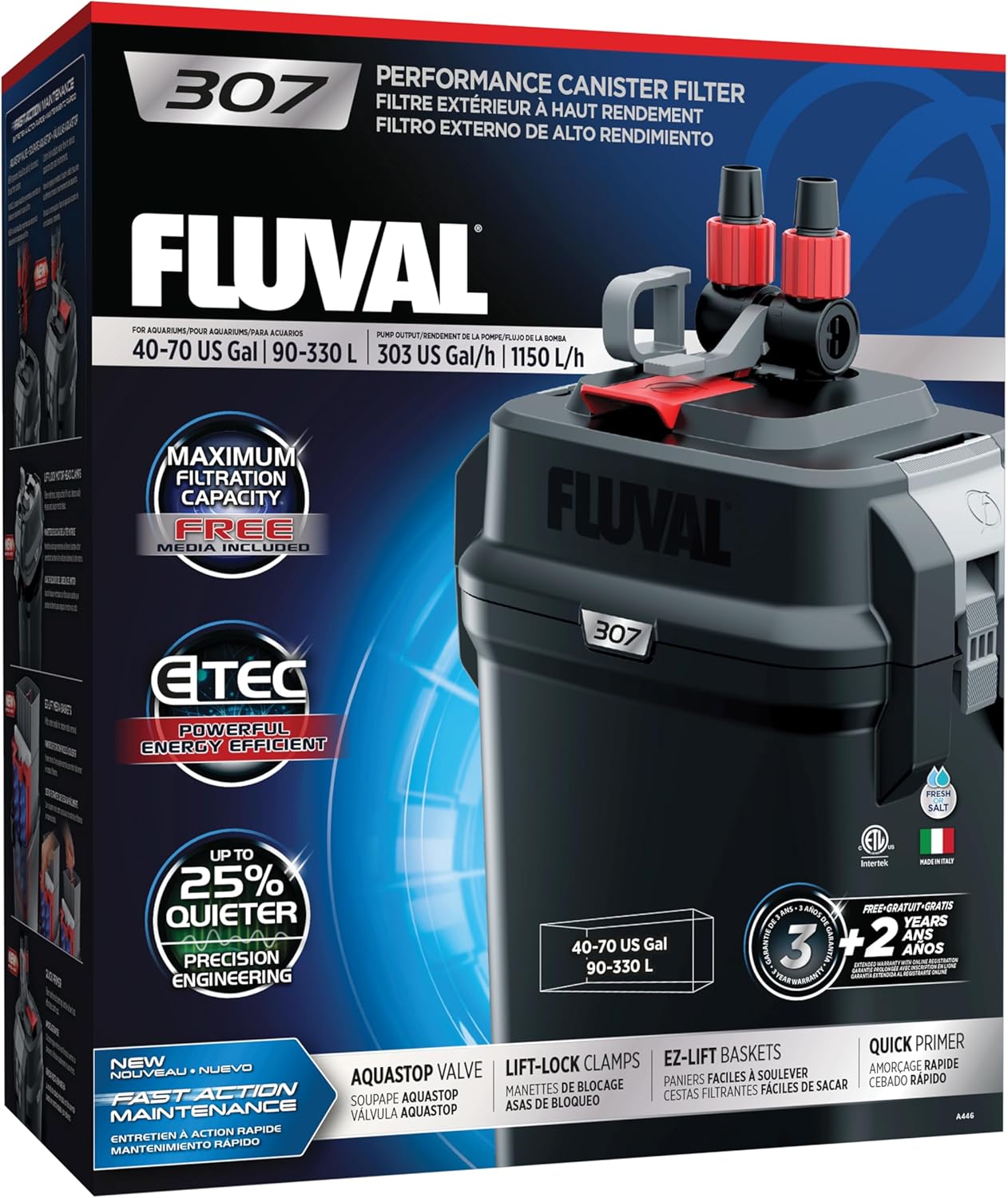
Fluval 307 Performance Canister Filter
Advanced 3-stage filtration (mechanical, chemical, biological) for tanks up to 70 gallons. Self-priming, quiet operation, and includes all filter media. The Aquarium Co-op filtration guide recommends canister filters for heavily stocked or planted tanks.
Check Amazon PriceProper Water Change Techniques
Regular water changes are essential for removing accumulated nitrates, dissolved organics, and replenishing minerals. Here's the correct way to perform water changes:
Prepare New Water
Fill a clean bucket with tap water and treat with water conditioner to remove chlorine/chloramine. Match temperature to aquarium water (±2°F). For sensitive fish, let water sit 24 hours or use reverse osmosis water with remineralizer.
Remove Old Water
Use a gravel vacuum to remove 20-30% of water while cleaning substrate. Start vacuuming away from plants and decorations. For planted tanks, limit substrate disturbance to 25% of area per water change.
Clean Filter Media
Rinse filter media in removed tank water (never tap water) to preserve beneficial bacteria. Replace chemical media (carbon, etc.) according to manufacturer schedule. Never replace all biological media at once.
Add New Water
Slowly add treated water to avoid disturbing fish and substrate. Use a plate or bowl to diffuse water flow. For large water changes (>50%), add water gradually over several hours.
Final Checks
Check temperature matches. Observe fish behavior for stress. Test water parameters after 1-2 hours to ensure stability. Record water change in maintenance log.
Water Change Schedule
- Heavily Stocked Tanks: 30-40% weekly
- Moderately Stocked: 20-30% weekly
- Lightly Stocked: 10-20% weekly
- Planted Tanks: 20-30% weekly (adjust based on nitrate levels)
- Saltwater Reef: 10-15% weekly
- New Tanks (first month): 10-15% twice weekly
Adjust based on your nitrate readings. Aim to keep nitrates below 20 ppm for most freshwater fish, below 10 ppm for sensitive species.
Choosing the Right Filtration System
Your filter is the heart of your aquarium's ecosystem. It provides three essential types of filtration:
Mechanical Filtration
Removes physical particles like fish waste, uneaten food, and debris. Uses sponge, floss, or pads. Should be cleaned regularly to prevent clogging and nitrate production from trapped organics.
Chemical Filtration
Removes dissolved impurities through adsorption. Activated carbon removes medications, tannins, odors. Specialty resins target ammonia, nitrates, or phosphates. Replace according to manufacturer schedule.
Biological Filtration
Houses beneficial bacteria that process ammonia and nitrite. Uses porous media like ceramic rings, bio-balls, or sponge. Never replace all biological media at once. Rinse only in tank water during water changes.
| Filter Type | Best For | Pros | Cons | Tank Size |
|---|---|---|---|---|
| Hang-on-Back (HOB) | Beginner to intermediate | Easy maintenance, affordable, good aeration | Limited media space, can be noisy | 10-75 gallons |
| Canister Filter | Advanced, planted, large tanks | Superior filtration, quiet, large media capacity | Expensive, more complex maintenance | 30-200+ gallons |
| Sponge Filter | Breeding tanks, hospital tanks | Excellent biological filtration, gentle flow, cheap | Poor mechanical filtration, requires air pump | 5-40 gallons |
| Internal Filter | Small tanks, betta tanks | Compact, easy to hide, affordable | Limited media, takes up tank space | 5-30 gallons |
| Sump System | Saltwater, reef, custom setups | Maximum filtration, hides equipment, customizable | Complex setup, requires planning/space | 50-500+ gallons |
Advanced Water Conditioner
Slime Coat Protection
Seachem Prime Fresh and Saltwater Conditioner
Concentrated conditioner that detoxifies ammonia, nitrite, and nitrate while removing chlorine and chloramine. Also adds slime coat for fish protection. According to Seachem Laboratories, 1ml treats 10 gallons, making it extremely cost-effective.
Check Amazon PriceCommon Water Quality Problems and Solutions
Even experienced aquarists encounter water quality issues. Here are common problems and their solutions:
Cloudy Water
White/Gray Cloudiness: Bacterial bloom from
new tank syndrome or overcleaning. Solution: Reduce feeding,
partial water changes, time.
Green Cloudiness: Algae bloom from excess
light/nutrients. Solution: Reduce light, water changes,
algae treatment.
Ammonia/Nitrite Spikes
Causes: Overfeeding, dead fish/plant,
filter failure, new tank.
Emergency Treatment: Immediate 50% water
change, add water conditioner that detoxifies ammonia,
reduce feeding, check filter.
Long-term: Ensure proper cycling, don't
overstock, regular maintenance.
pH Crashes
Causes: Low KH (carbonate hardness),
organic acid buildup, overuse of pH-lowering products.
Solution: Test and increase KH with crushed
coral or baking soda (1 tsp per 50 gallons increases KH by
~2 dKH). Perform gradual water changes with properly
buffered water.
Excessive Algae Growth
Causes: Excess nutrients (nitrates,
phosphates), too much light, insufficient plants to
compete.
Solution: Reduce lighting to 8 hours daily,
increase water changes, add fast-growing plants, manually
remove algae, consider phosphate-removing media.
Case Study: Resolving Chronic Water Issues
I worked with a client whose 55-gallon community tank had persistent issues despite regular maintenance:
- Problem: Fish consistently dying, water always slightly cloudy, nitrates constantly over 40 ppm
- Investigation: Discovered they were replacing ALL filter media monthly, cleaning gravel too thoroughly, and feeding 3x daily
-
Solution:
- Stopped replacing biological media, only rinsing in tank water
- Reduced feeding to once daily, amount consumed in 2 minutes
- Implemented 25% weekly water changes instead of monthly
- Added live plants to absorb excess nutrients
- Result: Within 4 weeks, water cleared completely, nitrates stabilized at 10-15 ppm, fish health improved dramatically, no further losses
This case demonstrates how multiple small issues can combine to create chronic water quality problems. Systematic troubleshooting is essential.

Weekly and Monthly Maintenance Schedule
Consistency is key to maintaining excellent water quality. Follow this schedule to keep your aquarium in optimal condition:
Aquarium Maintenance Calendar
- Check temperature
- Observe fish behavior
- Feed appropriate amounts
- Check equipment operation
- Remove visible debris
- Test ammonia, nitrite, nitrate
- 25% water change
- Clean aquarium glass
- Trim plants if needed
- Check filter flow rate
- Test pH, KH, GH
- Clean filter intake/outflow
- Vacuum substrate thoroughly
- Check/test heater accuracy
- Inspect equipment for wear
- Complete parameter test
- Clean filter media (in tank water)
- Replace chemical media
- Prune/trim plants extensively
- Check all equipment connections
Maintenance Log Template
Keep a simple log to track your aquarium's health:
- Date: Record all maintenance activities
- Water Parameters: Document test results
- Maintenance Performed: Water change %, filter cleaning, etc.
- Observations: Fish behavior, plant growth, algae
- Additions/Changes: New fish, plants, equipment
This log helps identify patterns and catch problems early. Digital or physical notebooks both work well.
Special Considerations for Planted Tanks
Planted aquariums have unique water quality considerations. Plants absorb nutrients and affect water chemistry:
CO2 Injection
Ideal: 20-30 ppm
Essential for plant growth in high-light tanks. Affects pH
(lowers it). Must be balanced with KH. Turn off at night to
avoid fish stress. Use drop checker to monitor levels.
Macronutrients
Nitrate (NO3): 10-20 ppm
Phosphate (PO4): 1-2 ppm
Potassium (K): 10-20 ppm
Essential for plant health. Balance is crucial to prevent
algae. Test regularly and dose accordingly.
Micronutrients
Iron (Fe): 0.1-0.5 ppm
Trace Elements: Regular dosing
Required in small amounts. Deficiency shows as poor growth,
pale leaves. Use comprehensive fertilizer if not dosing
individually.
Lighting Balance
Duration: 6-10 hours daily
Intensity: Match to plant needs
Too much light + insufficient nutrients = algae. Too little
light = poor plant growth. Use timer for consistency.
Planted Tank Water Change Considerations
- Frequency: 30-50% weekly to reset nutrient levels
- Timing: Before fertilizing to avoid wasting nutrients
- Substrate Cleaning: Limit to visible debris to preserve root systems
- Fertilizer Adjustment: Reduce dosing after large water changes
- CO2 Adjustment: May need to increase after water changes as pH rises
Planted tanks often require more frequent water changes than fish-only tanks due to fertilization and organic buildup from plant debris.
Saltwater Aquarium Water Quality
Saltwater aquariums, especially reef tanks, demand even more precise water quality management:
| Parameter | Fish-Only Tank | Reef Tank (Soft Corals) | Reef Tank (SPS Corals) | Testing Frequency |
|---|---|---|---|---|
| Salinity | 1.020-1.025 sg | 1.023-1.026 sg | 1.025-1.026 sg | Weekly |
| pH | 7.8-8.4 | 8.0-8.4 | 8.1-8.4 | Daily |
| Alkalinity | 7-10 dKH | 8-11 dKH | 8-9 dKH | 2-3x weekly |
| Calcium | 350-450 ppm | 400-450 ppm | 420-450 ppm | Weekly |
| Magnesium | 1250-1350 ppm | 1300-1400 ppm | 1350-1400 ppm | Monthly |
| Nitrate | <20 ppm | <10 ppm | <5 ppm | Weekly |
| Phosphate | <0.5 ppm | 0.03-0.1 ppm | 0.01-0.03 ppm | Weekly |
Saltwater Mixing Tips
- Use RO/DI water (reverse osmosis/deionized) for mixing saltwater
- Mix 24 hours in advance with heater and powerhead for complete dissolution
- Test salinity with refractometer (calibrated regularly), not hydrometer
- Match temperature and pH to display tank before water changes
- Store mixed saltwater with circulation to prevent precipitation
- Never add salt directly to aquarium - always mix externally
For detailed saltwater mixing instructions, see our complete saltwater aquarium setup guide.
Final Thoughts on Aquarium Water Quality
Maintaining excellent aquarium water quality is both a science and an art. It requires understanding the chemical and biological processes in your tank, consistent monitoring, and regular maintenance. The effort pays off with healthy, vibrant fish, beautiful plant growth, and a stunning aquatic display.
Remember these key principles:
- Test regularly - Don't guess, test!
- Consistency is key - Fish adapt to stable conditions, even if not "perfect"
- Make changes gradually - Sudden parameter shifts are more harmful than imperfect parameters
- Prevention over treatment - Good water quality prevents most health issues
- Every aquarium is unique - Learn what works for your specific setup
Your fish depend completely on you for their environment. By mastering aquarium water quality, you're giving them the best possible chance for a long, healthy life. That's the true reward of successful fish keeping.