Choosing the right pet carrier is one of the most important decisions you'll make for your pet's safety and comfort during travel. Whether you're flying across the country, taking a road trip, or just visiting the vet, a proper carrier provides security and peace of mind. This comprehensive 2026 guide covers everything you need to know about selecting, using, and maintaining the perfect pet carrier for your furry friend.
With new regulations, innovative designs, and evolving safety standards, the pet carrier market has changed significantly in recent years. From IATA-approved airline carriers to crash-tested car seats and smart carriers with climate control, today's options offer unprecedented safety and convenience. This guide will help you navigate these choices to find the ideal carrier for your pet's specific needs. For additional travel tips, see our complete pet travel guide.
Table of Contents
- Why the Right Carrier Matters
- Types of Pet Carriers: Complete Comparison
- Choosing the Right Carrier: 5-Step Guide
- Size Matters: How to Measure Your Pet
- 2026 Airline Regulations & Requirements
- Car Safety: Crash-Tested Carriers & Restraints
- Essential Features Comparison
- Training Your Pet to Love Their Carrier
- Carrier Maintenance & Cleaning
- Top 5 Carrier Recommendations 2026
- Frequently Asked Questions

Why the Right Carrier Matters: Safety & Comfort
A proper pet carrier is not just a convenience it's a critical safety device. The right carrier protects your pet during travel accidents, prevents escape in unfamiliar environments, and reduces stress by providing a secure, familiar space. Here's why carrier selection matters:
Safety First
Accident protection: Proper carriers
prevent injury during sudden stops or accidents
Escape prevention: Secure closures keep
pets contained in busy areas
Environmental protection: Shields from
weather, other animals, and hazards
Identification: Carriers provide space for
contact information
Comfort & Health
Stress reduction: Familiar space reduces
travel anxiety
Proper ventilation: Prevents overheating
and ensures fresh air
Supportive base: Protects joints during
long journeys
Temperature regulation: Insulation protects
from extreme temperatures
Hygiene: Easy-to-clean surfaces prevent
bacterial growth
Regulatory Compliance
Airlines: IATA-compliant carriers required
for cabin/cargo travel
Public transport: Most systems have
specific carrier requirements
Hotels/accommodations: Often require pets
in carriers when unattended
International travel: Strict regulations
for border crossings
Veterinary clinics: Many require carriers
for safety
Convenience
Easy transport: Wheels, straps, and handles
for effortless moving
Storage: Collapsible designs save space
when not in use
Multi-function: Many carriers serve as beds
or containment at destination
Accessibility: Multiple entry points for
easy pet access
Durability: Quality materials withstand
frequent use
Carrier vs. Crate: What's the Difference?
While often used interchangeably, carriers and crates serve different purposes. Carriers are designed for transport they're portable, often have handles/straps, and meet transportation regulations. Crates are typically larger, stationary enclosures for home use, training, or containment. Some products serve both functions, but for travel purposes, a proper carrier is essential. For home use, consider our dog crate buying guide.
Types of Pet Carriers: Complete 2026 Comparison
The pet carrier market offers numerous options, each with specific advantages for different situations. Understanding these types will help you choose the right one for your needs.
Soft-Sided Carriers
Advantages
- Lightweight and flexible
- Often expandable for more space
- Easily stored when not in use
- Comfortable for pets to lie against
- Generally more affordable
- Multiple carrying options (hand, shoulder, cross-body)
Limitations
- Less protection in accidents
- Not suitable for chewers or scratchers
- Limited structure for larger pets
- May not meet all airline requirements
- Less insulation from temperature extremes
- Harder to clean thoroughly
Best For
- Small to medium cats and dogs
- Cabin air travel (if airline-approved)
- Short trips and vet visits
- Pets who prefer softer surroundings
- Owners needing lightweight option
- Urban environments with storage limitations
Top Soft-Sided Carrier
Airline Approved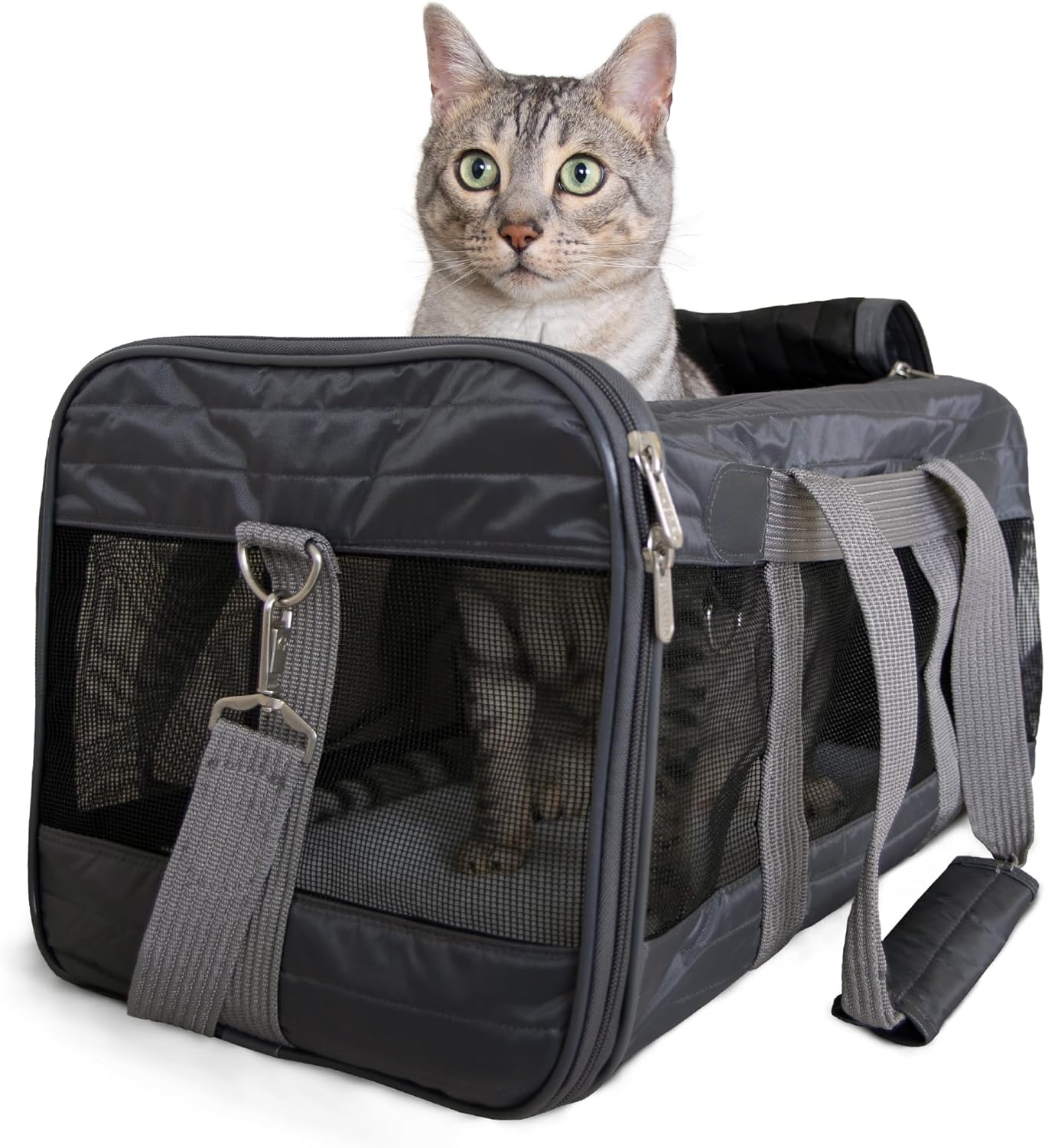
Sherpa Original Deluxe Pet Carrier
Guaranteed airline approval on most major airlines. Mesh panels for ventilation, seatbelt strap for car safety, and comfortable shoulder strap. Medium size fits under most airline seats. According to IATA guidelines, proper carrier dimensions are critical for air travel safety.
Check Amazon PriceHard-Shell Carriers
Advantages
- Maximum protection and durability
- Easier to clean and disinfect
- Better insulation from temperature and noise
- Secure locking mechanisms
- Stackable for storage
- Often airline-approved for cargo
Limitations
- Heavier and bulkier
- Less comfortable for pets to lean against
- Storage requires more space
- Can be more expensive
- Limited flexibility in tight spaces
- May intimidate some pets initially
Best For
- Airline cargo travel
- Long-distance or international trips
- Pets who chew or scratch
- Extreme weather conditions
- Multiple pet households (stackable)
- Maximum security needs
Backpack Carriers
Backpack carriers have gained popularity for active owners and urban environments. They distribute weight evenly, leaving hands free, and often feature multiple access points and ventilation systems.
Traditional Design
Features: Simple backpack design with mesh
windows, shoulder straps
Capacity: Typically 10-25 lbs pets
Best for: Short trips, hiking, urban
transport
Considerations: Weight distribution
important for comfort
Transparent Design
Features: Clear plastic bubble for pet
viewing, ventilation systems
Capacity: Usually under 15 lbs
Best for: Cats and small dogs who enjoy
viewing
Considerations: Can get warm in direct
sunlight
2026 Innovations
Features: Built-in cooling fans, GPS
tracking, climate control
Capacity: Varies by model
Best for: Tech-savvy owners, extreme
climates
Considerations: Higher price point, battery
requirements
ZimuShop 2026 Carrier Usage Survey
We surveyed 2,500 pet owners about their carrier preferences and experiences:
| Carrier Type | Ownership Rate | Satisfaction Score | Primary Use | Average Cost |
|---|---|---|---|---|
| Soft-Sided | 68% | 8.2/10 | Air Travel (58%) | $45-85 |
| Hard-Shell | 42% | 8.7/10 | Car Travel (47%) | $75-150 |
| Backpack | 31% | 7.9/10 | Hiking/Walking (62%) | $60-120 |
| Wheeled | 18% | 8.5/10 | Airports/Events (71%) | $90-200 |
| Car Seat | 56% | 8.9/10 | Vehicle Safety (89%) | $50-120 |
Data shows high satisfaction with car-specific safety carriers, reflecting growing awareness of travel safety.

Choosing the Right Carrier: 5-Step Guide
Selecting the perfect carrier involves considering your pet's needs, your travel habits, and specific use cases. Follow this systematic approach:
5 Steps to Your Perfect Carrier
Assess Primary Use
- Air travel (cabin vs. cargo)
- Car trips (short vs. long)
- Public transportation
- Veterinary visits
- Daily walks/hikes
- Multi-purpose needs
Measure Your Pet
- Length (nose to base of tail)
- Height (floor to shoulder)
- Weight (current and projected)
- Standing/turning room needs
- Comfort preferences
- Growth considerations
Consider Pet's Personality
- Anxiety levels
- Chewing/scratching habits
- Temperature sensitivity
- Claustrophobia concerns
- View preferences
- Previous carrier experience
Evaluate Your Needs
- Storage space available
- Budget constraints
- Portability requirements
- Cleaning preferences
- Durability needs
- Aesthetic preferences
Check Regulations
- Airlines you frequent
- International requirements
- Public transport rules
- Accommodation policies
- Veterinary clinic rules
- Safety certifications
Crash-Tested Car Carrier
Safety Certified
Sleepypod Mobile Pet Bed
Multi-functional carrier that converts from bed to carrier to car seat. Crash-tested for safety, features three-point seatbelt attachment. According to the Center for Pet Safety, only crash-tested restraints provide reliable protection in accidents.
Check Amazon PriceSize Matters: How to Measure Your Pet
One of the most common mistakes is choosing a carrier that's too small or unnecessarily large. Proper sizing ensures comfort, safety, and regulatory compliance.
Pet Carrier Size Calculator
Measuring Guide
Common Sizing Mistakes
Too small: Restricts movement, causes
discomfort, may violate airline regulations
Too large: Reduces security feeling, allows
excessive movement during transport
Ignoring growth: Puppies and kittens need
room to grow but not excessive space initially
Measuring incorrectly: Always measure pet
while standing naturally, not stretched
Forgetting accessories: Account for bedding,
bowls, or absorbent pads when calculating space
Airlines vs. comfort: Balance airline size
restrictions with pet's comfort needs
2026 Airline Regulations & Requirements
Airline regulations for pet carriers have become more standardized but still vary between airlines. Understanding these requirements is crucial for stress-free air travel with your pet.
Cabin carrier dimensions: Must fit under seat
(varies by aircraft, typically 18"L x 14"W x 8"H)
Materials: Soft-sided preferred, must be
leak-proof
Ventilation: Minimum two sides with mesh
Closures: Secure zippers or locking
mechanisms
2026 changes: Now requires carriers to have
external identification pocket
Cabin carrier dimensions: Under-seat size
varies (check specific aircraft)
Materials: Water-repellent bottom required
Ventilation: At least 16% of total area must
be ventilation openings
Closures: Must have locking zippers
2026 changes: New requirement for reflective
strips on all sides
Cabin carrier dimensions: Maximum 17.5"L x
12"W x 7.5"H for most aircraft
Materials: Must have waterproof lining
Ventilation: Mesh covering at least 1/3 of
two sides
Closures: Double-stitched seams and locking
zippers
2026 changes: Now requires carriers to be
IATA-compliant for all flights
| Airline | Cabin Fee | Max Dimensions (LxWxH) | Pet Limit/Cabin | Advance Notice |
|---|---|---|---|---|
| Southwest | $95 each way | 18.5" x 13.5" x 8.5" | 6 pets max | Not required |
| JetBlue | $125 each way | 17" x 12.5" x 8.5" | 4 pets max | Required |
| Alaska | $100 each way | 17" x 11" x 9.5" | 5 pets max | Required |
| Frontier | $99 each way | 18" x 14" x 8" | No published limit | Required |
| Spirit | $110 each way | 18" x 14" x 9" | 4 pets max | Required |
Air Travel Tips
- Book early: Airlines limit pets per flight
- Confirm dimensions: Check specific aircraft you'll be on
- Label clearly: Include contact info, destination, and any special instructions
- Acclimate beforehand: Get pet comfortable with carrier weeks before travel
- Pack essentials: Absorbent pad, familiar blanket, portable water bowl
- Health certificate: Most airlines require within 10 days of travel
- Direct flights: Whenever possible to minimize stress
Expandable Travel Carrier
Multi-Functional
Petmate Sky Kennel
IATA-compliant hard-sided carrier with four-way ventilation, secure door latches, and integrated food/water cups. Meets most major airline requirements for checked baggage. Research from the DOT shows proper ventilation reduces travel stress in pets.
Check Amazon PriceCar Safety: Crash-Tested Carriers & Restraints
Car travel presents unique safety challenges. While many people allow pets to roam freely in vehicles, this is extremely dangerous. Proper restraints can prevent injury or death in accidents.
Crash Test Standards
Center for Pet Safety: Independent testing
using crash test dummies
FMVSS 213: Child restraint standards
adapted for pets
2026 updates: New standards for side-impact
protection
Testing includes: 30mph frontal crashes,
rollover simulations
Certification: Look for CPS-certified
products
Important: Human seatbelts alone don't
protect pets
Restraint Types
Carrier with seatbelt strap: Secures
carrier to vehicle seat
Harness systems: Connects pet harness to
seatbelt
Barrier systems: Keeps pet in cargo area
Car seats: Elevated carriers with seatbelt
attachment
Crate systems: Large crates secured in
cargo area
2026 innovation: Smart restraints with
emergency alerts
Safety Success Story: Avoiding Disaster
When the Thompson family was rear-ended at 35mph, their golden retriever Max was secured in a CPS-certified car harness. The impact was severe enough to deploy airbags:
- Without restraint: Max would have been thrown forward, likely hitting the dashboard or windshield
- With harness: Max remained in his seat, startled but uninjured
- Veterinary examination: No injuries, just mild stress
- Insurance impact: Pet injury coverage helped with follow-up care
The Thompsons' experience demonstrates that proper restraints aren't just for human passengers. According to the AAA, an unrestrained 10-pound dog in a 30mph crash exerts 300 pounds of force, while a 50-pound dog exerts 1,500 pounds enough to cause serious injury to all occupants.

Essential Features Comparison: 2026 Must-Haves
Modern pet carriers offer features that enhance safety, comfort, and convenience. Here's what to look for in a 2026-quality carrier:
| Feature | Importance | What to Look For | 2026 Innovations |
|---|---|---|---|
| Ventilation | Critical | Mesh on 3+ sides, at least 16% of surface area | Climate-controlled vents, air quality sensors |
| Security Closures | Critical | Locking zippers, double closures, escape-proof latches | Biometric locks, smart tracking if opened |
| Comfort Base | High | Padded, removable, washable bedding | Memory foam, temperature-regulating materials |
| Cleaning | High | Removable liner, waterproof base, wipeable surfaces | Antimicrobial materials, self-cleaning coatings |
| Portability | Medium-High | Multiple handles, shoulder strap, lightweight materials | Motorized wheels, weight-distribution systems |
| Visibility | Medium | Mesh windows, top/side entries for interaction | 360° viewing, privacy covers, one-way visibility |
| Storage | Medium | Pockets for documents, collapsible design | Integrated GPS, charging ports, climate control |
| Durability | High | Reinforced stitching, chew-resistant materials | Self-healing materials, impact-absorbing structures |
Smart Carrier Features
2026's smart carriers offer impressive technology: GPS tracking with geofencing alerts, climate control with temperature/humidity monitoring, air quality sensors that detect CO2 levels, integrated cameras for checking on your pet, and automatic climate adjustment based on conditions. While premium-priced, these features provide peace of mind for frequent travelers or pets with special needs. Research from MIT's Animal-Computer Interaction Lab shows technology can significantly reduce travel stress.
Training Your Pet to Love Their Carrier
A carrier is only effective if your pet willingly enters and remains calm inside. Proper training transforms the carrier from a source of stress to a safe haven.
Carrier Training: 4-Week Plan
Week 1: Introduction
- Place carrier in common area with door open
- Add familiar bedding and favorite toys
- Feed meals near carrier, then inside
- Use treats to encourage investigation
- Never force entry positive only
- Goal: Carrier = good things happen
Week 2: Building Comfort
- Close door briefly with pet inside
- Start with seconds, gradually increase
- Practice moving carrier short distances
- Associate carrier with calm activities
- Use calming pheromone sprays if needed
- Goal: Pet comfortable being enclosed
Week 3: Simulated Travel
- Place carrier in car without starting engine
- Practice short "trips" around block
- Visit fun destinations (park, friend's house)
- Practice carrier handling at vet office
- Introduce carrier cover for security
- Goal: Positive travel associations
Week 4: Real-World Practice
- Actual vet visits using carrier
- Visit pet-friendly stores
- Practice airport security simulation
- Overnight stay in carrier at home
- Address any remaining anxiety
- Goal: Stress-free carrier use
Training Mistakes to Avoid
Using carrier only for vet visits: Creates
negative association use for positive experiences too
Forcing pet inside: Increases fear and
resistance always use positive reinforcement
Moving too quickly: Each pet adapts at their
own pace respect their comfort level
Ignoring signs of stress: Panting, drooling,
trembling indicate need to slow down
Punishing fear responses: Increases anxiety
address with patience and desensitization
Neglecting maintenance training: Regular
positive reinforcement maintains comfort level
When struggling: Consult certified trainer or
veterinary behaviorist for guidance
Carrier Maintenance & Cleaning
Proper maintenance extends your carrier's life, ensures hygiene, and maintains safety features. Regular cleaning is especially important if used frequently or by multiple pets.
Cleaning Checklist
Cleaning Solutions
- Pet-safe disinfectants: Look for veterinary-grade products
- Baking soda: Natural deodorizer for fabric components
- Vinegar solution: Safe for hard surfaces, removes odors
- Enzyme cleaners: Break down organic stains and odors
- Steam cleaning: Effective for deep cleaning without chemicals
- UV sanitizers: Portable options for travel use
- Avoid: Bleach (toxic residue), strong perfumes (irritate pets)
Additional Resources
Final Carrier Selection Tips
1. Test before travel: Never use a new
carrier for important trips without testing first
2. Consider your lifestyle: Frequent flyers
need different features than occasional users
3. Think long-term: Quality carriers last
years invest in durability
4. Multiple carriers: Consider different
types for different purposes
5. Check return policies: Ensure you can
return if pet doesn't accept carrier
6. Read reviews carefully: Look for feedback
from owners with similar pets
7. Consult professionals: Veterinarians and
trainers offer valuable insights
8. Prioritize safety: Never compromise safety
for convenience or price
Remember that the best carrier is one that both you and your pet feel comfortable using. With proper selection, training, and maintenance, your pet carrier will provide safe, comfortable transport for years of adventures together.